

INTRODUCTION
The survival of all animals depends upon their ability to detect potentially harmful (“noxious”) stimuli in their environment. This enables them to avoid or minimise bodily harm, so that they might find sufficient food and reproduce successfully.
The detection of and response to harmful stimuli involves complex physiological processes that appear to have been conserved through evolution. The evidence for this can be found at both chemical and behavioural levels in the animal world.
This process is called nociception, which this article will show is the key to understanding persistent pain.
NOCICEPTORS AND NOCICEPTION
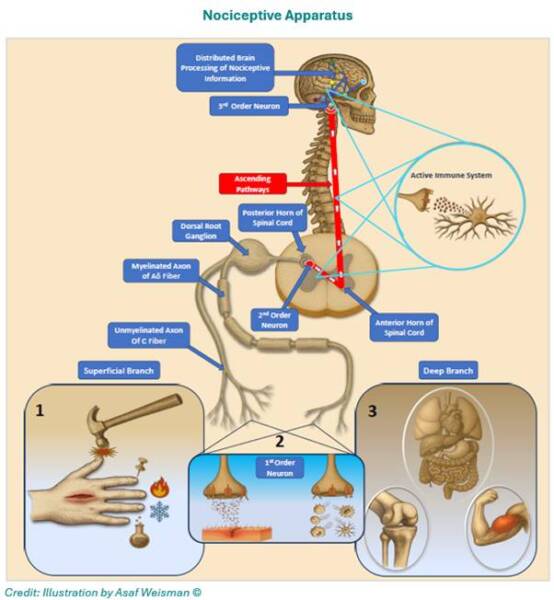
Animals have specialised receptors in body tissues that detect noxious stimuli, coined “nociceptors” by the British neurophysiologist Sir Charles Sherrington (1857-1952) [Sherrington 1906]. Nociceptors can be activated by mechanical and chemical stimuli as well as by extremes of environmental temperature, (Point 1 in the diagram). Insert Illustration – Illustration courtesy of Asaf Weisman. Point 2 shows that activation depends upon a variety of channels and receptors. Nociceptors have a high threshold for activation, which means they require a relatively large amount of stimulation, in contrast to receptors that register touch, pressure, warm or cool. Many nociceptors respond to combinations of these stimulus types. They are called “polymodal” nociceptors. Most nociceptive information is carried from nociceptors by specialised nerve fibres which synapse onto (“connect with” or “clasp”) second-order neurons in the spinal cord. They project upwards to targets in the midbrain, thalamus and cerebrum (the largest part of the brain) [Coghill 2020] constituting a very complex system. Sherrington [1906] also coined the term “nociception” for this important process.
NOCICEPTIVE APPARATUS
The concept of a “nociceptive apparatus” has been re-emphasised over the past few years. Invertebrates and vertebrates possess segregated (“set apart”) sensory pathways within the nervous system dedicated to the transmission of nociceptive information. They are widely distributed, allowing different elements to perform the same function [Coghill 2020]. This allows nociception to adapt and maintain functionality even when some of its components are disrupted. These properties explain the failure of many attempts to relieve pain by cutting relevant nerves and their pathways within the body. This brings us to a very important distinction.
NOCICEPTION AND PAIN ARE NOT THE SAME PHENOMENON
Nociception is the signalling to the organism that bodily damage has occurred. However, nociception is not always associated with pain. For example, a soldier injured in the heat of battle may not instantly experience pain. The pain experience comes later. Pain, certainly in humans, is a complex response that is driven by nociception in the first instance but may be modified by a host of other factors. This is why we speak of a biopsychosocial framework for pain, in which nociception is the dimension of what is happening to the body. In addition to this, there is also what is happening to the person, labelled the “psychological” dimension and what is happening in the persons’ word, labelled the “social” dimension. It is also why we speak of “nociceptive” nerves and pathways, not “pain” nerves and pathways. The fact that nociceptive information may be prevented from reaching the brain, and thus not being associated with a pain experience, raises the issue of how nociception may be modulated.
MODULATION OF NOCICEPTIVE FUNCTION
“Switch-off”: inhibition of nociception
The function of the ascending pathways that carry nociceptive information to the brain can be inhibited by substances originating elsewhere in the body, especially the immune system. This arrangement allows for the necessary dynamic shifts in the balance of nociception in accordance with the organism’s priorities at the time [Heinricher et al. 2008].
“Switch-on”: sensitisation of nociception
In biology, “sensitisation” refers to a state of increased responsiveness to a stimulus. In the context of neurophysiology, sensitisation is characterised by a decreased threshold for discharge and/or increased amplitude of activity of nerves, in this case nociceptive pathways.
(a) Peripheral sensitisation of nociception
Activation of nociceptors in response to a noxious stimulus is usually but not always associated with a pain experience. Activated nociceptors may become sensitised such that they discharge in response to non-noxious stimulation. The end result for the person may still be pain but tissue damage is no longer occurring. This is the common experience of “tenderness”: the part hurts – it is “painful” – when it is touched or moved gently – that is, a non-noxious stimulus well after any acute injury has healed. Technically, this phenomenon is called allodynia (literally, “other pain”). Other examples of allodynia include experiencing pain from clothing brushing against the skin, or from a cold breeze blowing onto skin in the area of pain. Clearly these stimuli are not noxious, so something has happened to the nociceptors such that they discharge and may lead to a pain experience: they have become sensitised.
(b) Central sensitisation of nociception
This neurophysiological process of sensitisation can also affect nociceptive pathways in the central nervous system. The phenomenon has been demonstrated in many different species but can only be inferred (i.e., arrived at by a well-informed guess based on clinical signs) in humans.
Central sensitisation of nociception occurs whenever spinal cord nociceptive neurons have been subjected to repeated episodes of noxious input from the relevant peripheral nerves. These neurons also become sensitised when exposed to various products released by nearby activated glial cells, which are now known to be part of the immune system.
In simple terms, peripheral and central sensitisation of nociception can be thought of as physiological enhancement of function of the nociceptive apparatus.
SICKNESS RESPONSE
“Pain, if severe, soon induces extreme depression or prostration; but it is first a stimulus and excites to action, as we see when we whip a horse …” (Darwin 1872, page 81)
Nociception can be viewed as protecting an injured animal from expressing behaviours that might interfere with its recovery, thus inducing behaviour appropriate to its survival.
Animals experiencing persistent nociception demonstrate sickness responses which appear to be analogous to the human experience after severe injury. These responses include inactivity, aversive responses to non-noxious stimuli (i.e., allodynia), prolonged sleep, depression, as well as disturbances of eating, grooming, and social behaviour.
“Pain, if severe, soon induces extreme depression or prostration; but it is first a stimulus and excites to action, as we see when we whip a horse …” (Darwin 1872, page 81)
EVIDENCE FOR THE ROLE OF NOCICEPTION IN NATURAL SELECTION
Recent insights from the field of evolutionary biology suggest that the experience of pain may reflect a “powerful evolutionary adaptation to severe bodily injury” [Walters 2023]. Studies in a number of animal groups – fruit flies, molluscs and rodents in particular [Burrell 2017] – indicate that persistent activity of nociceptors has undergone evolutionary selection by being associated with survival long after bodily injury.
Several hypotheses have been proposed to explain why chronic pain in humans is a major clinical problem. One is that nociceptive mechanisms that drive chronic pain after bodily injury were originally adaptive because they increased the chances of an injured animal’s survival. The persistent nociceptor hyperactivity that has been demonstrated in a number of different phyla (large group of animals) might be an evolutionary adaptive response in which primitive molecular mechanisms originally related to cellular injury have been repurposed towards survival.
We are left with an evolutionary mystery – “why would natural selection shape a regulation mechanism that expresses pain when it is no longer needed?” [Nesse & Schulkin 2019]. A partial explanation is the “fire alarm principle”. It makes more sense for an alarm to ring loudly when a fire is relatively small than for it to wait until it has grown large.
IMPLICATIONS FOR THERAPY
Many instances of chronic pain in humans are likely to be examples of persistent activation of the nociceptive apparatus. Just how this occurs is the subject of intense research, complicated by the puzzle of why something that seems so maladaptive for humans has been so adaptive in an evolutionary sense.
Meanwhile, there has been much research interest into measures that might inhibit the transmission of nociceptive information to the brain in the first place [Sirucek et al. 2023]. In other words, trying to target nociception itself, in addition to the other therapies commonly used such as analgesic medications (targeting “pain”), physical therapies (mindful of allodynia), cognitive and behavioural (“psychological’) approaches and addressing social factors that influence the experience of pain such as stigmatisation. Discussion of these is beyond the scope of this article.
CONCLUSION
Pain in humans – and its analogue in non-verbal animals – is a phenomenon that does not occur without nociception. The function of nociception in signalling to the organism that it has encountered a noxious agent appears to have played a unique role in an evolutionary sense. Persistent nociceptor activation may be the necessary precursor for survival behaviour in non-human animals that is analogous to the human experience of pain.
Although the human “behaviour” of chronic pain may appear to be maladaptive, natural selection has favoured mechanisms that respond to tissue damage by increasing the sensitivity of the nociceptive apparatus, because for our survival “the cost of more pain is often vastly less than the cost of too little pain” [Nesse & Schulkin 2019].
An ongoing challenge at all levels – clinical, scientific and societal – is to recognise that nociception and pain, while related in the sense that pain does not occur without nociception, are not the same, and require different yet coordinated therapeutic approaches.
Authors: John Quintner, Consultant Physician in Rheumatology and Pain Medicine (retired) & Professor Milton Cohen, MD FRANCP FFPMANZCA.
Reviewed by Melanie Galbraith, APA Pain Physiotherapist, BSc(Physio), MScMed(PainMgt)
References:
- Burrell BD. Comparative biology of pain: what invertebrates can tell us about how nociception works. J Neurophysiol 2017;117(4):1461-1473. doi: 10.1152/jn.2016.00600.
- Coghill RC. The distributed nociceptive system – a framework for understanding pain. Trends Neurosci 2020;43(10):780-794. doi: 10.1016/j.tins.2020.07.004.
- Darwin C. The Expression of the Emotions in Man and Animals. New York: Appleton, 1872.
- Heinricher MM, Tavares I, Leith JL, Lumb BM. Descending control of nociception: specificity, recruitment and plasticity. Brain Res Rev 2008;60(1):214-225. doi: 10.1016/j.brainresrev.2008.12.009.
- Nesse RM, Schulkin J. An evolutionary medicine perspective on pain and its disorders. Phil Trans R Soc B. 2019;374:20190288. doi: 10.1098/rstb.2019.0288.
- Sherrington CS. The integrative action of the nervous system, London, Archibald Constable & Co., 1906.
- Sirucek L, Ganley RP, Zeilhofer HU, Schweinhardt P. Diffuse noxious inhibitory controls and conditioned pain modulation: a shared neurobiology within the pain inhibitory system? Pain 2023;164(3):463-468. doi: 10.1097/j.pain.0000000000002719
- Walters ET. Exaptation and evolutionary adaptation in nociceptor
mechanisms driving persistent pain. Brain Behav Evol 2023;98(6):314–330. doi:10.1159/000535552.